WEBSITES + LOCAL SEARCH FOR PLUMBING COMPANIES

Make Your Plumbing CompanyEasier to Find, Trust, and Call.

We rebuild plumbing websites around what a homeowner needs to see — your services, your service area, your experience, your reviews, and a clear way to reach you. The Google side is handled as part of the same job: your Business Profile, your review replies, and the local-search foundation underneath.

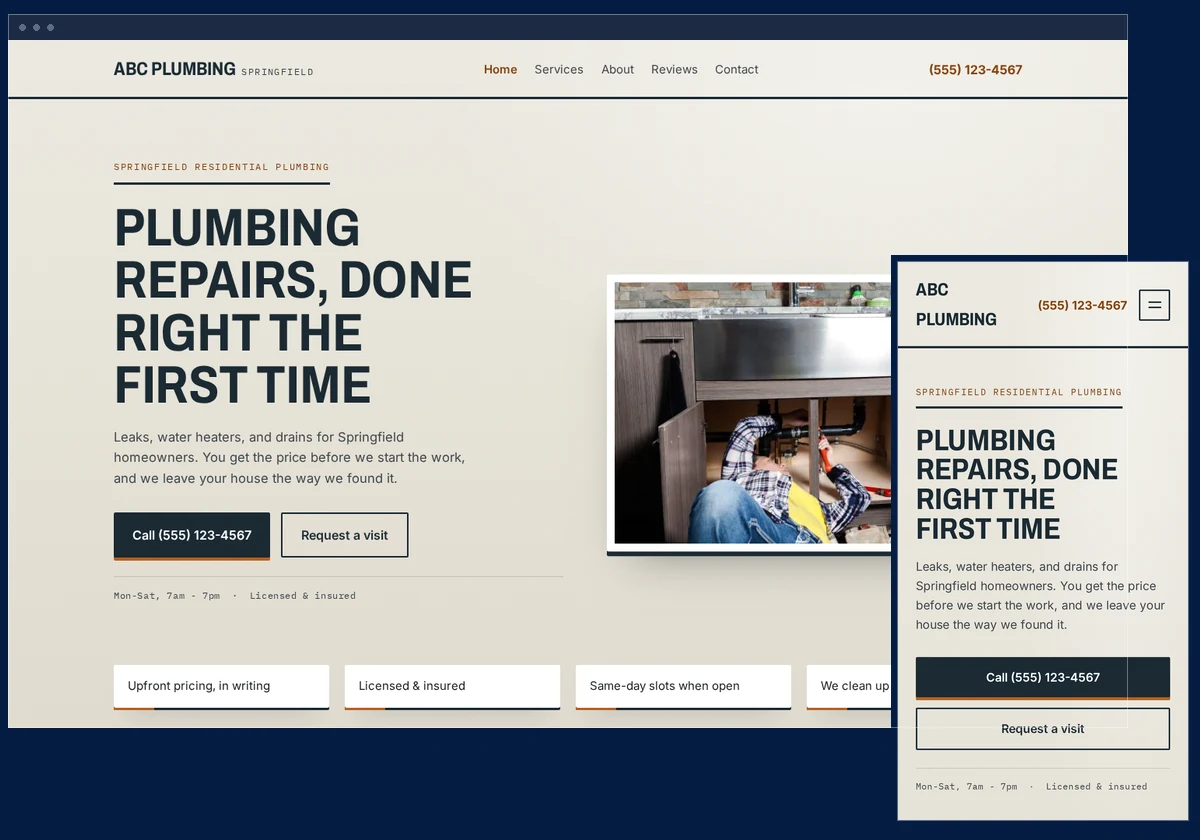
A sample plumbing website shown on a desktop browser with the phone version in front of it: the company name and city, the phone number, a headline, a call button and a request-a-visit button, opening hours, and a row of four short claims about pricing, licensing, availability, and cleanup.
PWP Sample Build
How it starts
Send the company name, the city you work in, and what you want help with online. We’ll reply by email with what we’d build and why. No call required.
Introductory rate
$2,297 for projects booked by October 20, 2026 — booked means the agreement is signed and the first payment received — including the first three months of Local Search Foundation. The Foundation build is $2,997 from October 21. Scope and any extras are confirmed in writing before we begin.

A Good Plumbing Business Can Outgrow Its Website

None of this means the site was built badly. It is what tends to happen when a business keeps moving for a few years and the website stays where it was. If none of it sounds familiar, leaving the site alone is a perfectly good answer.

  1. The reviews kept coming

    Reviews and repeat customers build up faster than a website changes. If the site was written before most of that happened, it describes a smaller business than the one answering the phone today.

  2. The service list grew

    Water heaters, repipes, drain work, a warranty that was not on the list three years ago — services get added one at a time, and the page that lists them tends to keep the shape it had the day it was written.

  3. The map got bigger

    New service areas, another truck, someone new answering the phone, different hours in the summer. These tend to change one job at a time, and the website is usually the last place they get written down.

  4. The link is the longer route

    The business is easy to explain out loud — what you do, who you send, what it costs, what happens if something goes wrong. When the site does not say it that plainly, sending someone the link stops being the short way to explain it.

Built Around Your Business

No two plumbing companies are the same. The site has to carry the business behind it — the services, the service area, the reputation, and the way the work actually comes in.

Plumbing is the entire business here, not one of six industries on a list. Emergency work, service areas, licensing and reviews are planned from the start, not discovered halfway through the build.

These are concept builds, not client sites — client work will be marked as such as it is added. Each one shows a decision, and the reason for it is written underneath.

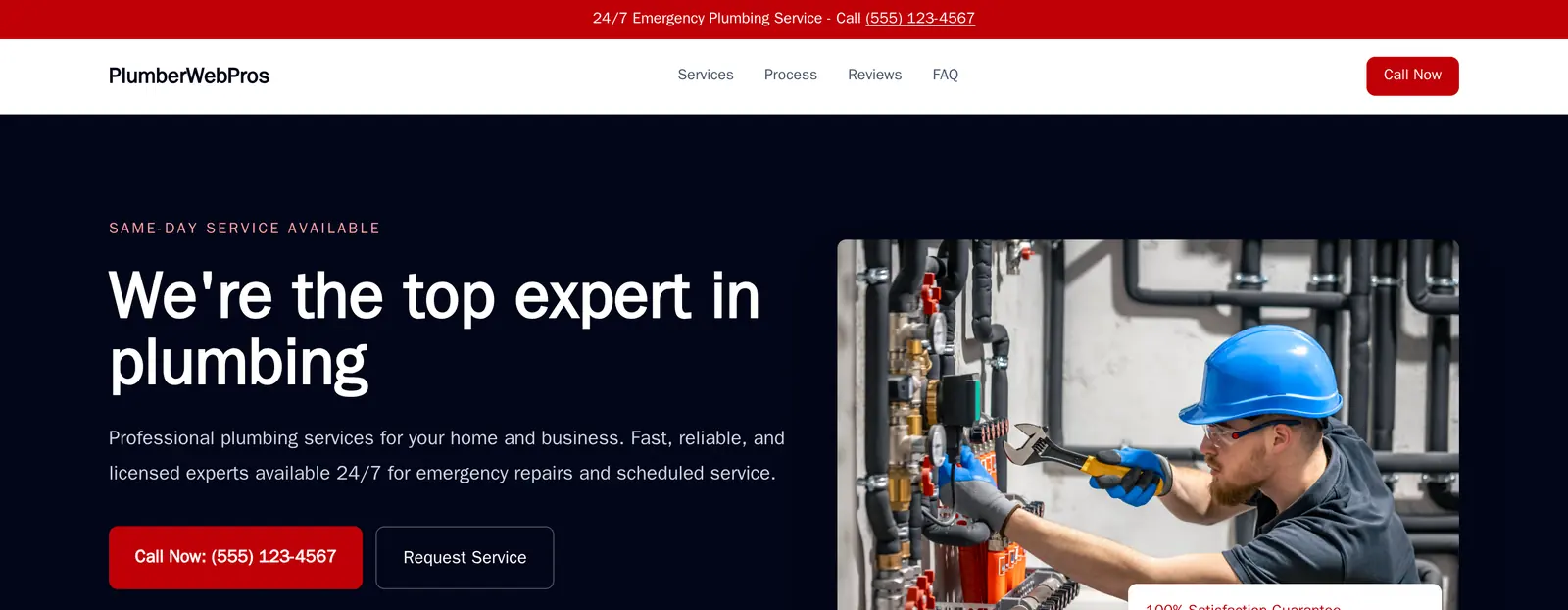
Concept homepage for a plumbing company: an emergency phone number in a bar across the top, and a hero with a call button and a request-service button side by side.
Concept Project

The essentials, before the first scroll

The emergency number sits in a bar above everything, and again inside the call button — nobody standing in water should have to hunt for it. Beside it, a second button for the people who would rather leave a message than talk. Two ways in, both before the first scroll.

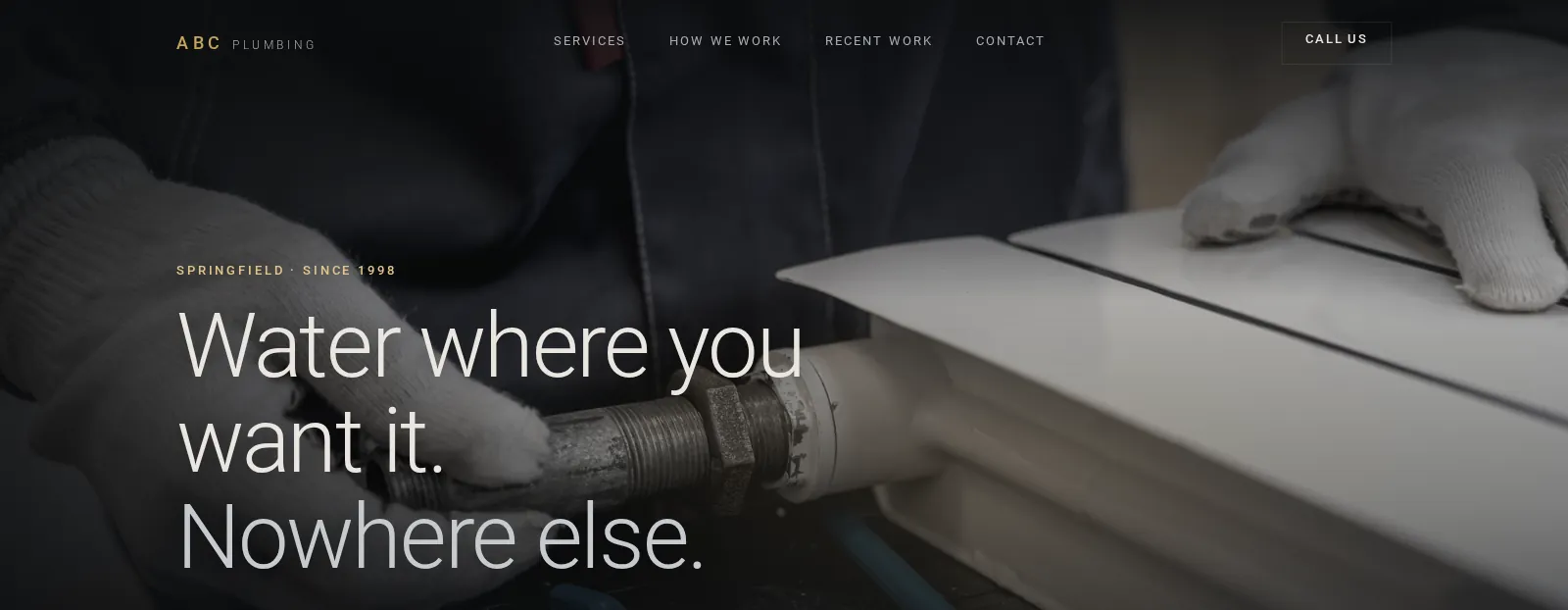
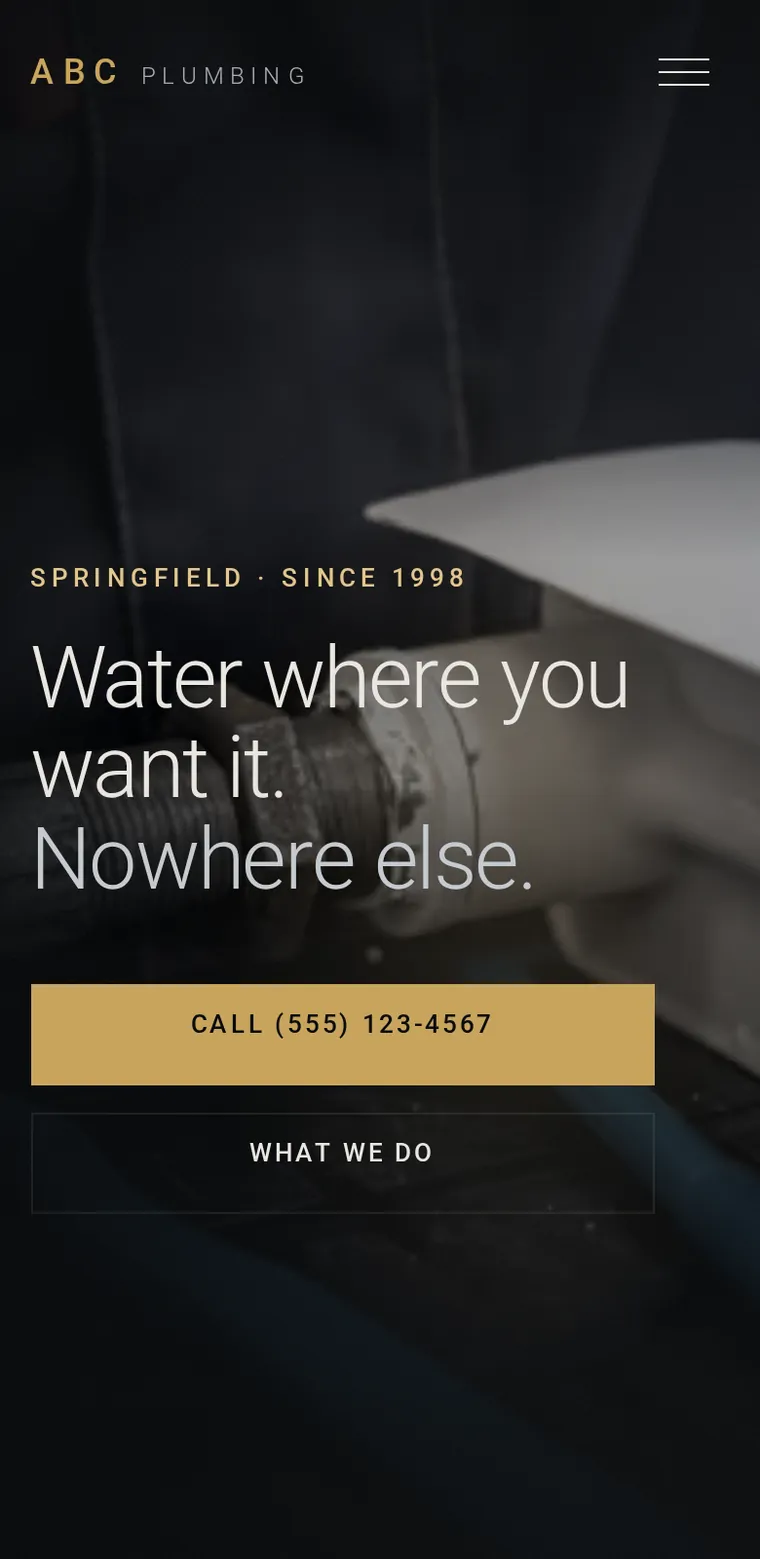
Concept homepage in a dark theme: a photograph of gloved hands fitting a pipe, with the city and founding year set above the headline.
Concept Project

One claim, one photograph, one way to call

The city and the year the business started sit right above the headline — the two things a customer checks first, answered before the first sentence. Everything else is left out: one photograph of the work itself, one line, one call button. Nothing competes for the tap.

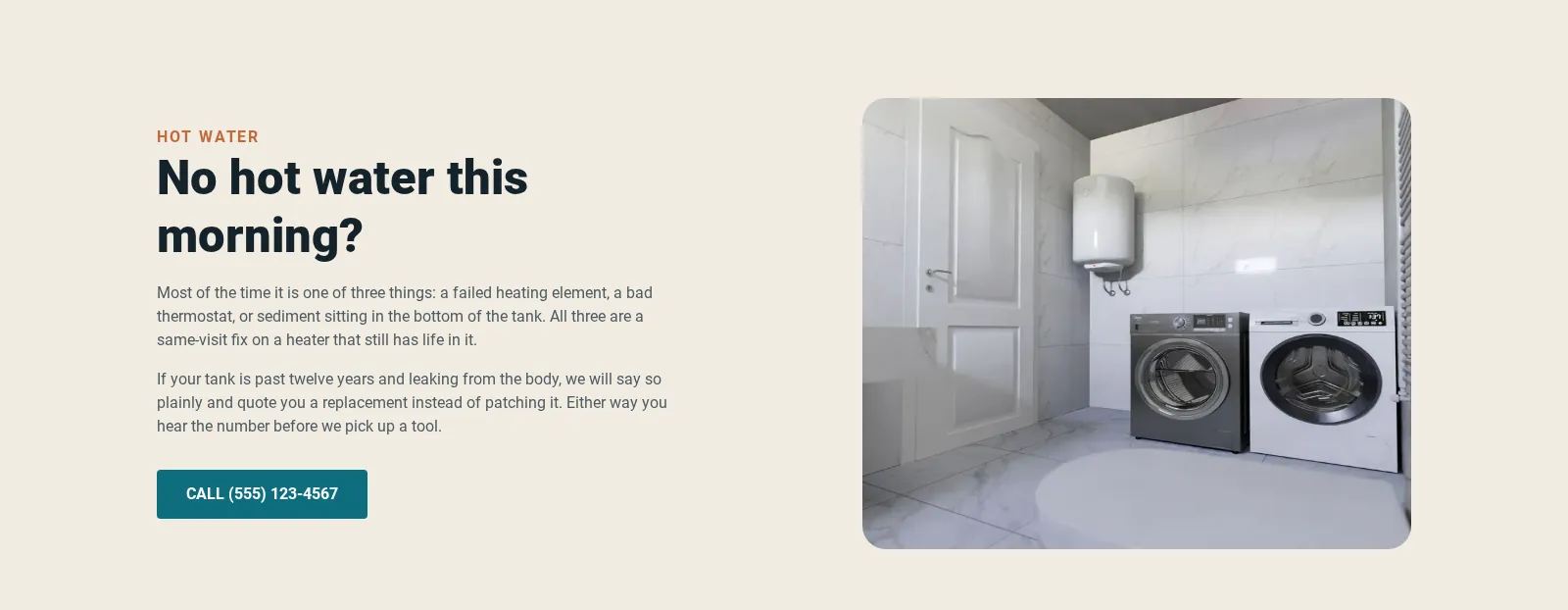
Concept service section: a heading asking about no hot water this morning, a plain-English explanation and a call button, beside a photograph of a wall-mounted water heater.
Concept Project

Written the way the customer would describe it

The heading starts with the problem — “No hot water this morning?” — not the name of the equipment. Under it, the likely causes in plain English, and a straight line about when a replacement is the honest answer instead of a patch. The call button comes after the explanation, not before it.

View Our Work

Built for How Customers Choose a Plumber

A plumbing website is not judged like a portfolio. It is often opened on a phone by someone who already has a problem, with the search results still one tap away.

A concept plumbing homepage on a phone: the city and founding year above the headline, and a full-width call button before the first scroll.
Concept · phone first
It happens on a phone
Usually mid-problem, often standing right next to it. So the phone layout is the design, and the desktop version is a variation of it — not the other way round.
Proof comes before persuasion
Reviews, license and insurance where applicable, years in business, and whether you cover where they live. Those answers belong where the decision is being made, not on an About page two clicks away.
One obvious next step
Tap to call, or leave a message and get one back. If it is outside working hours, the page should say what happens next instead of leaving them to guess.
The listing and the site have to agree
People cross between your Google listing and your website without noticing they crossed anything. Same name, same number, same hours, and consistent core services. Visible mismatches create doubt.

None of this is about taste. It is about the moment someone decides whether to call you or go back to the search results.

Our Standard

A standard is only worth stating if it can be checked. These four are checked on every build.

Build Standard

Mobile-first layouts, real load-speed checks, a page structure built from your services and service areas, forms tested with a real submission, and the search essentials in place before launch.

Launch Standard

Before launch, every site is walked through by hand on real devices: tap-to-call on an actual phone, reviews linking to the right profile, license and insurance shown where they apply, and business information kept consistent wherever it appears.

Delivery Standard

A written launch report — what was checked, what was built, the state the site went live in, and anything we know is still open. Nothing is “done” just because it was said out loud.

Communication Standard

Scope and price agreed in writing before work starts, progress updates while it runs, a reply within one business day Monday through Friday, and any change of scope confirmed in writing. You work directly with the person responsible for the site — there is no sales team.

See the full standard

The Website Is Just the Beginning

Launch is where the relationship starts, not where the job ends.

Your website, your Google Business Profile, your reviews and the way you show up in local search are not four separate jobs. They reinforce one another, so they are planned together and looked after together.

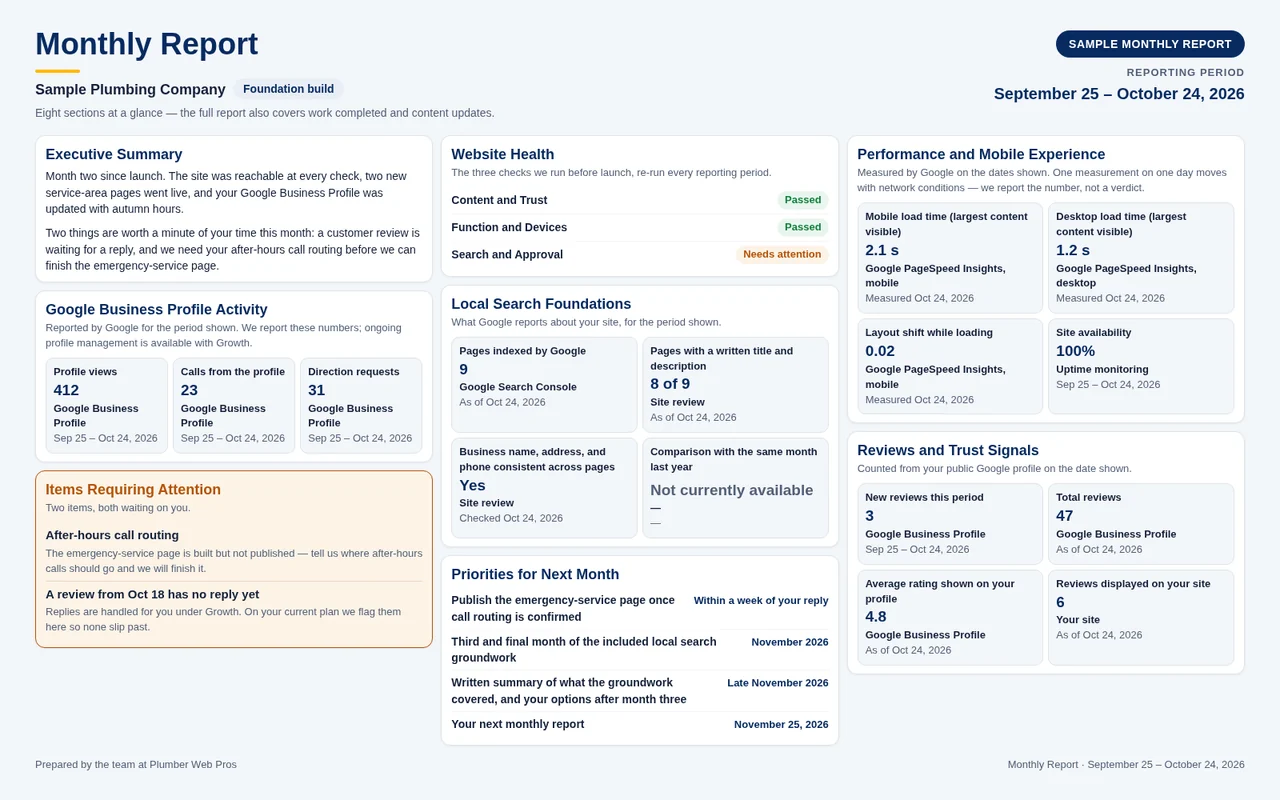
The first three months are already part of the build. The site stays monitored and up to date, the local-search groundwork underneath it keeps going — Google Business Profile, reviews, the way your business information reads across the web — and you get a written report of what was actually done. No position in the search results is promised, then or later.

From there, you choose what happens next. Some businesses carry on with the monthly work, some just want the site looked after, some want neither — and the site stays online and stays theirs. No paid service starts without your written go-ahead.

The monthly report is there to be judged, not filed. The monthly work stays month to month — if the report cannot justify it, you can stop by email.

What happens after launch
A sample Foundation monthly report for a fictional plumbing company: executive summary, the three pre-launch checks re-run, Google Business Profile activity, page speed and availability measured by Google, review counts, and the priorities for next month.
Sample · Foundation monthly report

Let’s Build What Your Business Needs Online.

Tell us the company name and what you want help with online. We’ll reply by email with a clear starting point — what we would build, what it includes, and what it costs. Replies go out within one business day, Monday through Friday.